Roof Cleaning & Soft Washing in East London
Those black streaks are algae feeding on your roof, not dirt sitting on it. High pressure blasts off the visible layer and damages your tiles in the process. Soft washing kills the growth at the root — gently — and keeps the roof clean for years instead of a season.
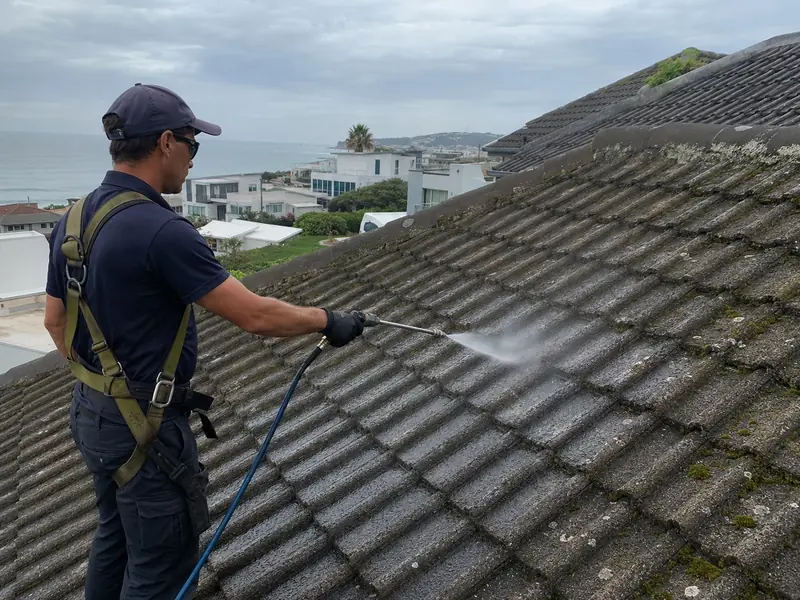
What the black streaks on your roof actually are
The dark staining that runs down East London roofs is almost always Gloeocapsa magma, a hardy blue-green algae that feeds on the limestone filler in concrete roof tiles. It is not dirt and it is not soot. It is a living organism with roots into the tile surface, which is why hosing it off never works for long.
Our climate suits it perfectly. Warm, humid coastal air and regular overnight dew give it exactly the moisture it needs, and south-facing roof slopes that stay shaded hold that moisture the longest. That is why the staining is almost always worse on one side of the roof than the other.
Where the algae takes hold, moss and lichen usually follow. Moss is the more damaging of the two: it holds water against the tile like a sponge, and it forces its way into the gap between overlapping tiles, lifting them slightly. Lichen is worse still in one respect — it bonds chemically to the tile surface and pulls material away when it eventually detaches.
None of this is cosmetic-only. A roof holding moisture stays cold and damp, ages faster, and in bad cases lets water track sideways under the tiles into the roof space.
Why we never pressure wash a roof
Pressure washing a roof is fast, dramatic and genuinely damaging. It is also, unfortunately, what most people picture when they think of roof cleaning.
Concrete roof tiles have a factory-applied protective slurry coating on the surface. That coating is what keeps the tile dense and water-resistant. A pressure washer strips it off, exposing the porous concrete underneath. The roof looks fantastic for a season, then goes green again faster than before — because the now-porous surface holds moisture better than it did originally.
On top of that, high pressure drives water sideways under the tile laps and into the roof space, dislodges bedding mortar on ridge caps, and can crack older or brittle tiles outright. On many roofs it voids the manufacturer's warranty. And critically, it only removes what you can see. The algae's root structure survives in the pores of the tile, which is why pressure-washed roofs regrow within months.
How soft washing works
Soft washing is the opposite approach: chemistry does the work instead of force, so the tile never takes a beating.
We apply a diluted, biodegradable treatment at low pressure across the whole roof surface. It kills the algae, moss and lichen at the root over the following days. The dead growth then weathers off naturally with rain and wind over the next few weeks, so the roof continues improving after we leave rather than looking its best on day one and declining from there.
Before we start we wet down surrounding plants and beds so nothing is affected, and we rinse everything down afterwards. We will ask you to keep pets indoors for the couple of hours we are treating.
Because the root structure is genuinely dead rather than just scrubbed off, a soft-washed roof typically stays clean for two to four years — against a single season for a pressure wash. It is a slower-looking process with a far better outcome.
What's included
- Full roof survey first, including a note of any cracked, slipped or broken tiles we can see. You get told, whether or not it changes the job.
- Plants and beds pre-wetted and protected before any treatment is applied.
- Low-pressure application across the whole roof, including the shaded slopes where growth is heaviest.
- Heavy moss removed by hand where it has built up in valleys and along ridges.
- Gutters cleared of the debris that comes down during the job — we do not leave that for you.
- Before and after photos and a realistic explanation of how the roof will keep improving over the following weeks.
A note on honesty about roofs
Not every roof should be cleaned. If the tiles are already badly deteriorated, if there is significant cracking, or if the roof is close to the end of its life, cleaning it is money spent on something that needs replacing. We will tell you that.
Equally, we will tell you when a roof only needs the shaded slope treated rather than the whole thing. We would rather quote a smaller job honestly than a bigger one hopefully — in a city the size of East London, the referral is worth more than the difference.
Areas we cover
We travel across East London and the surrounding coastal suburbs: Gonubie, Nahoon, Beacon Bay, Bonnie Doon, Vincent, Winterstrand, Sunnyridge, Kidd's Beach and Cove Rock, as well as Berea, Vincent, Amalinda, Cambridge, Quigney, Selborne and Abbotsford. If you are outside these areas, message us anyway — we regularly travel further for larger jobs.
Roof Cleaning FAQs
Will pressure washing damage my roof?
Yes, it can. High pressure strips the protective coating off concrete tiles, dislodges ridge mortar, forces water under the tile laps, and can crack older tiles. It also only removes the visible layer, so the algae regrows within months. That is why we soft wash instead.
How long does a soft-washed roof stay clean?
Typically two to four years, because the treatment kills the algae, moss and lichen at the root rather than just removing what you can see. A pressure-washed roof usually looks green again within a single season.
Is the treatment safe for my plants and pets?
Yes, when applied properly. We pre-wet surrounding plants and beds before we start, use a diluted biodegradable treatment, and rinse everything down afterwards. We will ask you to keep pets indoors for the couple of hours we are working.
Why does my roof still look dirty right after treatment?
That is expected and it is how soft washing works. The treatment kills the growth, then the dead algae and moss weather off gradually with rain and wind over the following weeks. Your roof keeps improving after we leave.
Do you walk on the roof?
Only where it is necessary and safe to do so, and we tread carefully on the tile laps where the structure is strongest. Most of the application is done without putting weight on the tiles at all.
How much does roof cleaning cost in East London?
From R2,200 for an average single-storey home. Price depends on roof area, pitch, how heavy the growth is and access. Send us a photo of the worst-affected slope on WhatsApp and we will quote the same day.