Solar Panel Cleaning in East London
Coastal salt haze, dust and bird droppings quietly cut what your panels produce — and rain does not wash it off. We clean with deionised pure water so your array dries perfectly spot-free, with no soap film left behind to catch the next layer of dirt.
Why solar panels in East London get dirty faster
East London sits on the coast, and that changes everything about how a solar array behaves. Salt-laden air drifts inland from the Indian Ocean and settles on glass as a fine haze. It is not loose dust — it bonds to the surface and hardens, especially on panels that get direct afternoon sun. Add the dust that blows in during the dry months, pollen off the coastal bush, and droppings from the gulls and hadedas that treat a warm north-facing roof as a perch, and you get a film that builds steadily from the day the system is commissioned.
What makes it costly is that the loss is invisible. Panels do not stop working; they quietly under-deliver. A homeowner in Gonubie or Beacon Bay looking at a slightly disappointing monthly generation figure usually assumes it is the weather. More often it is the glass.
The other coastal factor is dew. Overnight moisture wets the salt film, it dries again in the morning sun, and each cycle bakes the deposit a little harder onto the glass. This is why panels near the sea need cleaning more often than the same system would inland — and why a proper clean has to lift the deposit rather than just rinse the surface.
How much output are dirty panels actually costing you?
Independent testing of soiled photovoltaic panels consistently shows meaningful output losses, with heavily soiled arrays performing well below their rated capacity. The exact figure depends on how thick the film is, how steep your roof is, and how long it has been since the panels were last cleaned — a flatter array holds dirt far longer than a steeply pitched one, because rain runs off rather than sheeting down the glass.
The practical way to think about it: if your system is meant to generate a certain number of units a month and a film across the glass is shaving a slice off that, you are paying for the shortfall every single month in grid electricity you did not need to buy. On most East London homes, a clean pays for itself well before the next one is due.
We will tell you honestly if we think your panels do not need cleaning yet. Selling you a clean you do not need is a bad way to build a business in a city this size.
Our pure-water method — and why it matters for panels
Solar panel glass has an anti-reflective coating. That coating is the reason a panel absorbs light rather than bouncing it away, and it is exactly what abrasive pads, harsh detergents and hard tap water damage. Once it is scratched or clouded, it does not come back.
So we do not use any of those. We run tap water through a filtration and deionisation system that strips out every dissolved mineral until the water is effectively pure. Pure water is unstable — it actively wants to pick up dirt — which is what makes it such an effective cleaner with no chemicals at all. And because there are no minerals left in it, there is nothing to leave behind when it evaporates. The panel dries completely spot-free without anyone touching it with a cloth.
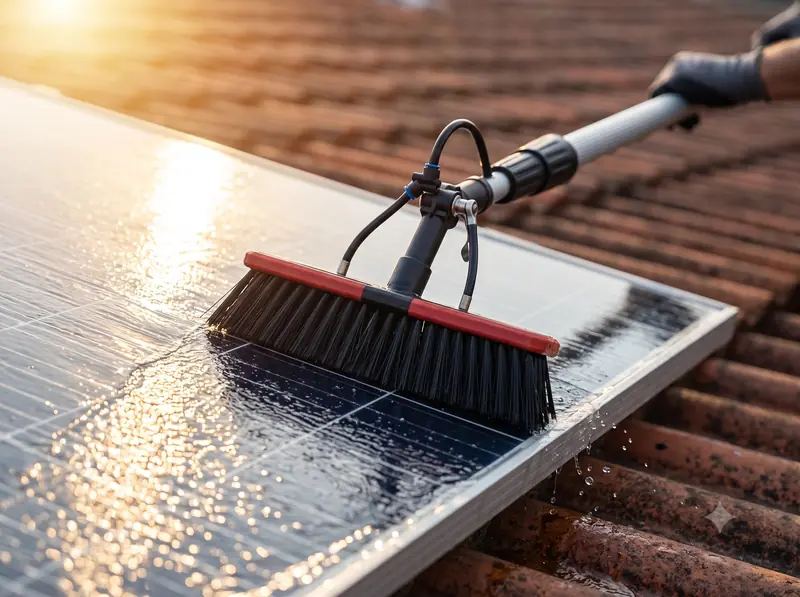
The water goes up a carbon-fibre water-fed pole with a soft brush head, so we clean from the ground wherever we can. That is safer for us and it means nobody is walking across your array. Standing on panels causes micro-cracks in the cells that do not show up until months later as dead spots in your output — it is one of the most common ways a well-meaning clean does lasting damage.
What a solar clean includes
- A quick condition check first. We look at the array before we start and tell you what we see — lifted clamps, cracked glass, a panel sitting proud, cabling that has come loose from its clips.
- Pure-water clean of every panel face, including the frames where dirt collects along the bottom edge and shades the lowest row of cells.
- Bird droppings and baked-on deposits worked off gently rather than scraped.
- Before and after photos sent to you on WhatsApp — most customers never see their own roof, so we show you.
- A note of anything worth watching, so you can raise it with your installer if it needs attention.
We do not touch the electrical side of your system. We are cleaners, not installers, and any wiring or inverter issue we spot gets reported to you to pass on to the person who fitted it.
How often should you have it done?
For most East London homes within a few kilometres of the sea, every three to six months keeps the array close to its clean-glass output. Further inland — Amalinda, Cambridge, Braelyn — you can usually stretch to twice a year.
Some situations need more attention: panels under a tree that drops sap or attracts birds, a flat or near-flat array that never self-rinses, or a property near a construction site or a gravel road. If yours falls into one of those, we will say so and suggest a realistic interval rather than a default one.
If you would rather not think about it, our Coastal Home Care plan puts panels, windows and gutters on a quarterly cycle at a lower per-visit price, and we simply message you when your visit is due.
Areas we cover
We travel across East London and the surrounding coastal suburbs: Gonubie, Nahoon, Beacon Bay, Bonnie Doon, Vincent, Winterstrand, Sunnyridge, Kidd's Beach and Cove Rock, as well as Berea, Vincent, Amalinda, Cambridge, Quigney, Selborne and Abbotsford. If you are outside these areas, message us anyway — we regularly travel further for larger jobs.
Solar Panel Cleaning FAQs
How often should solar panels be cleaned in East London?
On the coast, every three to six months. Salt haze, dust and bird droppings build a film that rain alone does not remove. Further inland, twice a year is usually enough. We will give you an honest interval for your specific roof rather than a standard answer.
Doesn't rain clean solar panels by itself?
No. Rain rinses loose dust but leaves mineral spots, salt film and baked-on droppings behind — much like a car that is only ever rained on. On a low-pitch array, rain can actually make it worse by pooling and drying into tidemarks.
Will cleaning scratch or damage my panels?
Not with our method. We use a soft brush with deionised pure water and no chemicals, and we clean from the ground with a water-fed pole wherever possible so nobody walks on the array. Standing on panels is what causes micro-cracks in the cells.
Do you need to switch my system off?
No. Cleaning the glass surface with pure water does not require the system to be shut down, and we do not touch any electrical component, connector or the inverter.
How much does solar panel cleaning cost in East London?
From R650 for up to about ten panels on a single-storey roof. Larger arrays, double-storey access and difficult pitches cost more. WhatsApp us a photo of your roof and we will give you an exact price the same day.
Can you clean panels on a double-storey house?
Yes. Our water-fed pole reaches up to three storeys from the ground. Send us a photo when you ask for a quote so we can confirm access and give you an accurate price.