Gutter Cleaning in East London
Blocked gutters cause damp walls, rotten fascias and cracked foundations — repairs that cost many times what a clean does. We clear every metre by hand and test-flush the downpipes so you know the water actually goes where it should before the next storm.
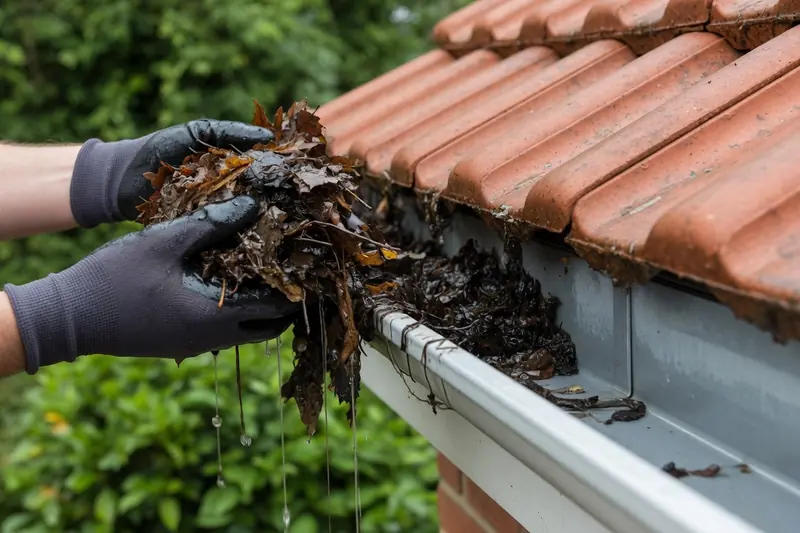
What a blocked gutter actually costs you
A gutter has one job: move water away from the building. When it cannot, that water has to go somewhere else, and every alternative is expensive.
The first thing that happens is that water spills over the front edge during heavy rain and runs down the wall. On a plastered wall this shows up as a dark vertical stain, then as bubbling paint, then as damp inside the room behind it. East London gets real downpours, and a gutter that copes fine with drizzle will overflow badly in a proper storm.
The second thing is what happens at the back. Debris packed against the fascia holds water permanently against the timber. Fascia and barge boards are usually the first structural element on a house to rot, and replacing a run of fascia plus repainting costs several times what a decade of gutter cleaning would have.
The third is at ground level. Water dumping off the roof in one place saturates the soil at the base of the wall, and repeated wetting and drying cycles move foundations. That is the expensive end of this problem, and it starts with a handful of leaves.
There is a pest angle too. Standing water in a blocked gutter is a mosquito nursery, and packed damp debris is exactly what wasps, ants and rodents look for in a nesting site right at roof level.
What goes into East London gutters
It is rarely just leaves. On coastal properties we routinely pull out a mix of windblown sand, dried salt crust, jacaranda and plane debris, pine needles from the plantations around the city, tile grit that has washed off the roof over the years, and — very often — a full nest.
Sand is the one people underestimate. It washes down off the roof, settles in the low points of the gutter run, and compacts into a dense layer that water simply sits on top of. It does not float out when you hose it, and you cannot see it from the ground. A gutter can look perfectly clear from the driveway and be half full of compacted grit.
Homes with overhanging trees need clearing more often, and homes near the beach need it for a completely different reason. Both need someone actually looking into the gutter rather than guessing from below.
How we do it
- Every metre cleared by hand. Debris is bagged and taken away, not flicked into your garden or left in a pile on the paving.
- Downpipes test-flushed, one by one, with water. This is the step most people skip. A clear gutter running into a blocked downpipe is still a blocked gutter.
- Gutter run checked for fall. If a section is sagging or has come loose from its brackets, water pools there permanently — we will show you where.
- Joints and outlets inspected for leaks and separation.
- Fascia condition noted so you can catch rot early rather than after it has spread.
- Photos of the before and after, including inside the gutter — the part you can never see.
We are cleaners, not roofers. If we find a section that needs re-hanging, a joint that needs sealing or fascia that needs replacing, we will tell you and photograph it so you can get a roofer in. We do not quote you for repairs we are not qualified to do.
When to have it done
The most useful time to clear gutters in East London is before the wet months, so the system is genuinely clear when the heavy rain arrives. Twice a year suits most homes; once a year is usually enough for a property with no overhanging trees.
If you have large trees anywhere near the roofline, plan for three times a year. If you have already had water coming over the front edge of the gutter in a storm, it is not a scheduling question any more — that gutter is already full.
Gutter clearing is also the natural companion to a roof soft wash, since dead moss comes down off the roof over the following weeks and needs somewhere to go. We clear gutters as standard at the end of every roof job.
Areas we cover
We travel across East London and the surrounding coastal suburbs: Gonubie, Nahoon, Beacon Bay, Bonnie Doon, Vincent, Winterstrand, Sunnyridge, Kidd's Beach and Cove Rock, as well as Berea, Vincent, Amalinda, Cambridge, Quigney, Selborne and Abbotsford. If you are outside these areas, message us anyway — we regularly travel further for larger jobs.
Gutter Cleaning FAQs
How often should gutters be cleaned in East London?
Twice a year suits most homes — ideally before the wet season. Once a year is usually enough with no overhanging trees; three times a year if there are large trees near the roofline. Coastal properties also collect windblown sand, which compacts and blocks flow.
Do you flush the downpipes as well?
Yes, every time, and we test each one with water. A clear gutter feeding a blocked downpipe is still a blocked gutter, and downpipe blockages are one of the most commonly missed problems.
What do you do with the debris?
We bag it and take it away. We do not flick it into your garden beds or leave a pile on your paving for you to deal with.
Can you tell me if my gutters need repairs?
We will tell you what we see and photograph it — sagging sections, loose brackets, separated joints, rotting fascia — so you can get a roofer in. We do not carry out gutter repairs ourselves, and we will not quote you for work we are not qualified to do.
How much does gutter cleaning cost in East London?
From R650 for an average single-storey home. Price depends on the length of the gutter run, the number of storeys, access, and how heavily blocked things are. Photos on WhatsApp get you a same-day price.
Do you clean gutters as part of a roof clean?
Yes. Every roof soft wash includes clearing the debris that comes down during the job. Dead moss continues weathering off for weeks afterwards, so gutters need to be clear to handle it.