Driveway & Paving Cleaning in East London
High pressure belongs on hard surfaces — not on your roof or your windows. We lift oil, moss, algae and years of ground-in grime off driveways, paving and pool surrounds, and can seal afterwards so it stays looking new for longer.
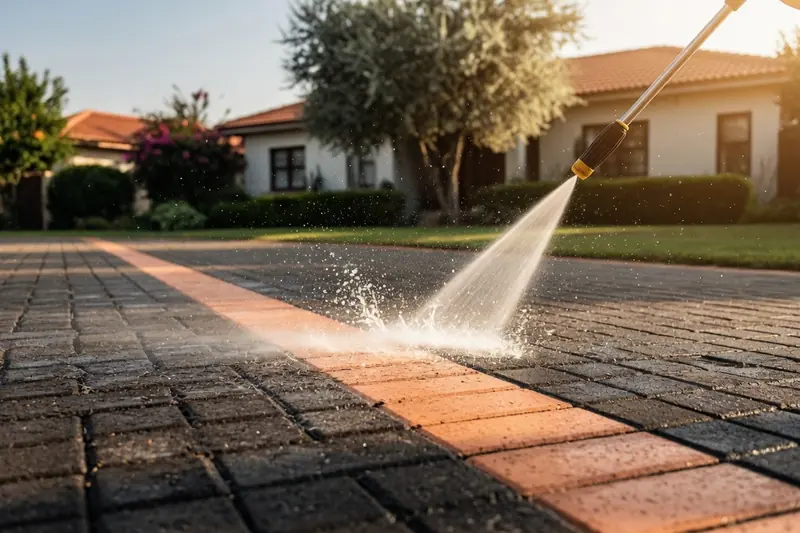
Why paving goes green in East London
Paving greens up here for the same reason roofs do: humidity, dew and shade. Any section of driveway or patio that does not get several hours of direct sun will grow a film of algae, and once that film is established it becomes slippery — which is a genuine safety issue on a sloped driveway or around a pool.
Concrete pavers and cast concrete are porous. They absorb water, oil, tyre marks and organic matter, and each of those works its way below the surface where sweeping and hosing cannot reach. Clay pavers are denser but hold moss in the joints. Natural stone and slate around pools are the most vulnerable, because they are usually the shadiest and wettest surfaces on the property.
Then there is what a car leaves behind. Engine oil, gearbox drips, brake dust and rubber build up in a predictable pattern in the middle of the driveway. Oil in particular sinks in over months, which is why it does not come off with a bucket and a brush.
This is where high pressure is the right tool
We are known for the opposite argument — we will not put a pressure washer anywhere near a roof or a solar panel. But paving is a different material with a different job to do, and here pressure is exactly right.
We use a rotary surface cleaner rather than a handheld lance for the main areas. It is a covered head that spins two jets at high speed across the surface at a fixed height. That does two things: it produces an even, consistent finish with no zebra striping from overlapping passes, and it keeps the dirty water contained instead of spraying it up your walls and windows.
Edges, steps and awkward corners are then done by hand with a lance so nothing is left half-cleaned along the boundaries.
For heavy organic staining or deep-set oil we pre-treat the area and let it dwell before washing, rather than simply turning the pressure up. Excessive pressure on paving erodes the surface of the paver and blows the jointing sand out from between the blocks, which leads to movement and weeds later. Getting the chemistry right first means we can use less force.
What's included
- Pre-treatment of heavy staining, oil patches and organic growth so the pressure does not have to do all the work.
- Even rotary surface cleaning across the main areas — no stripes, no missed patches.
- Hand-detailing of edges, steps and corners.
- Full rinse-down afterwards, including the walls and any glass that caught spray.
- Joint sand replaced where washing has displaced it on block paving.
- Optional sealing — quoted separately, and worth it on porous concrete or around a pool.
Should you seal afterwards?
Sealing is not automatically the right answer, and we will not push it as an add-on.
It makes real sense on porous concrete pavers, on light-coloured paving that stains easily, and around pools where you want to slow down algae coming back. It fills the surface pores so oil and organic matter sit on top instead of soaking in, which makes the next clean far easier and stretches the interval between cleans considerably.
It makes less sense on very old paving that is already breaking down, on surfaces that drain poorly, or where you are planning to replace the paving in the next couple of years. In those cases you are sealing in a problem rather than solving one.
We will tell you which category your driveway falls into when we quote. Sealing is always priced separately so you can see exactly what it costs and decide on its own merits.
How often
Most East London driveways benefit from a clean every twelve to eighteen months. Shaded paving, pool surrounds and anything under trees go on the shorter end of that; a sunny north-facing driveway can stretch longer.
If your paving is sealed, you can typically double the interval — which is the practical argument for sealing more than the appearance one.
Areas we cover
We travel across East London and the surrounding coastal suburbs: Gonubie, Nahoon, Beacon Bay, Bonnie Doon, Vincent, Winterstrand, Sunnyridge, Kidd's Beach and Cove Rock, as well as Berea, Vincent, Amalinda, Cambridge, Quigney, Selborne and Abbotsford. If you are outside these areas, message us anyway — we regularly travel further for larger jobs.
Driveway Cleaning FAQs
Will pressure washing damage my paving?
Not when it is done properly. We use a rotary surface cleaner at controlled pressure and pre-treat heavy staining so we do not have to crank the pressure up. Excessive pressure erodes the paver surface and blows out the jointing sand, which causes movement and weeds later.
Can you remove oil stains from a driveway?
Usually, yes — though how much comes out depends on how long the oil has been sitting and how porous the surface is. We pre-treat oil patches and let the treatment dwell before washing. Very old, deeply soaked stains may lighten significantly rather than disappear entirely, and we will tell you that upfront.
Do you replace the sand between block pavers?
Yes. Washing inevitably displaces some jointing sand, so we re-sand the joints as part of the job. Leaving that out is what causes pavers to shift and weeds to come through afterwards.
Should I seal my driveway after cleaning?
It depends. Sealing helps a lot on porous concrete, light-coloured paving and pool surrounds, and it roughly doubles how long the surface stays clean. It makes little sense on paving that is already breaking down or that you plan to replace soon. We quote it separately so you can decide on its own merits.
How often should a driveway be cleaned?
Every twelve to eighteen months for most East London homes. Shaded paving, pool surrounds and areas under trees need it more often; a sunny north-facing driveway can go longer. Sealed surfaces roughly double the interval.
How much does driveway cleaning cost in East London?
From R850 for an average driveway. Price depends on the area in square metres, the surface type, and how heavy the staining is. WhatsApp us a photo and we will quote the same day.