Roof Cleaning in Stilbaai
You can't see your own roof from the stoep, and when the house stands empty nobody else is looking either. We soft-wash tiled and fibre-cement roofs at low pressure, rinse the salt off metal roofs, and tell you what we found: cracked tiles, slipped ridges, rust spots and all.
What grows on a coastal roof
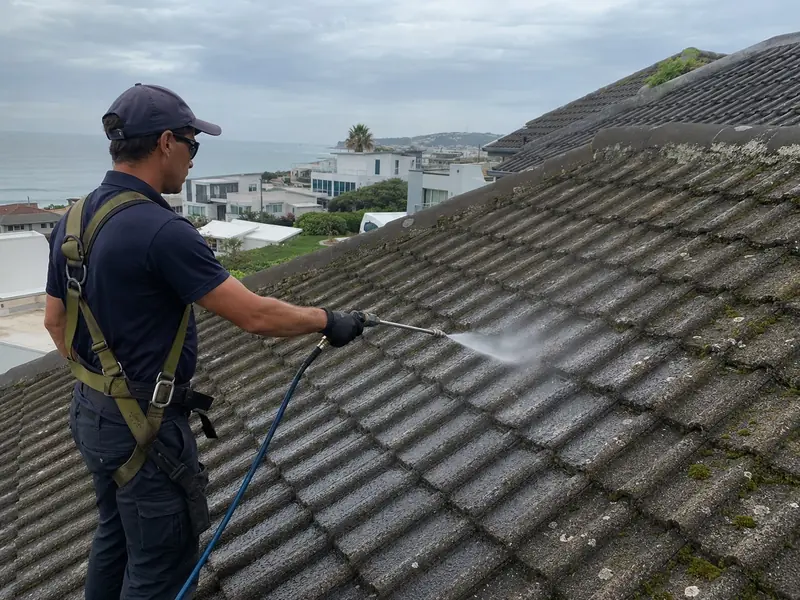
The dark streaks on concrete-tile roofs are usually algae (Gloeocapsa magma), not dirt. It feeds on the limestone filler in the tiles and thrives on the dew that settles on a roof near the sea almost every night. Lichen, the grey-green crusty patches, grows alongside it, and on the shaded side of the roof moss starts packing into the gaps between the tiles.
It isn't only cosmetic. Moss holds water against the tiles and lifts them slightly at the laps, and a roof that stays damp ages faster. On a house that stands empty most of the year, a small leak can run for a whole winter before anyone sees the stain on the ceiling.
Why we never pressure wash a roof
High pressure strips the protective coating off concrete tiles, drives water in under the laps, loosens ridge mortar and cracks brittle tiles. The roof looks good for a season and then goes green faster than before. Soft washing uses a diluted, biodegradable treatment at low pressure that kills the growth at the root. The dead growth then weathers off over the following weeks, and the roof usually stays clean for two to four years.
Metal and fibre-cement roofs near the sea
Sheeting manufacturers' care guides generally recommend rinsing coastal metal roofs in places the rain doesn't reach, such as under overhangs and around flashings, because salt left sitting there speeds up corrosion. We rinse those areas as part of the job and point out any rust spots, lifted screws or damaged flashings.
Fibre-cement sheeting grows lichen and algae much like tiles do and is soft-washed the same way. Older sheets can be brittle, and we treat them with that in mind.
Thatched roofs
We don't clean or treat thatch. It needs a specialist thatcher, and the treatment used on tiles is not suitable for it. If your house has a thatched main roof with tiled or sheeted outbuildings, we can do those and leave the thatch to the experts.
What's included
- A roof survey first, noting any cracked, slipped or broken tiles and damaged flashings.
- Garden beds and plants wetted and protected before any treatment goes on.
- Low-pressure treatment of the whole roof, not just the visible streaks.
- A salt rinse on metal roofs, flashings and under overhangs.
- Gutters checked and rinsed through after treatment.
Pricing
Roof cleaning starts from R2,200 for an average single-storey home, and most roofs come to R3,000 to R5,500. Roof type, pitch, size and access set the price. Send a photo from the street or a satellite view of the roof from Google Maps, and we'll give you a price.
Areas we cover
We work across Stilbaai on both sides of the Goukou River, in Stilbaai West and Stilbaai East, as well as Jongensfontein and Melkhoutfontein. Further along the coast or inland? Ask us. We can often fit it in.
Roof Cleaning FAQs, Stilbaai
Can you check my roof while I'm away?
Yes. A roof survey is part of every roof clean, and a roof condition check is included in our Full Arrival Ready package.
How long does a soft-washed roof stay clean?
Usually two to four years, because the growth is killed at the root rather than just blasted off the surface.
Do you clean thatched roofs?
No. Thatch needs a specialist thatcher. We can clean tiled or sheeted outbuildings and leave the thatch alone.
Is the treatment safe for my garden?
We wet and protect plants before treatment and rinse them afterwards, and we keep run-off away from the pool. Tell us about fish ponds so we can plan for them.